

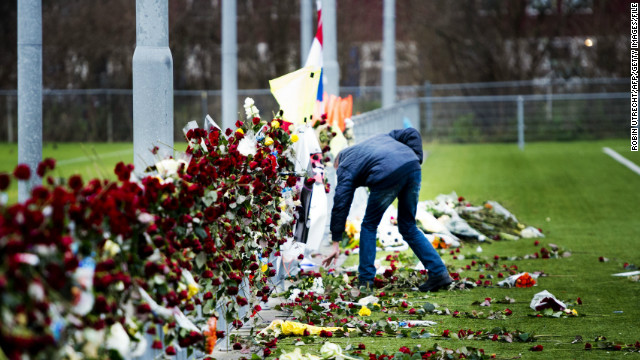
Soccer violence: Referees under siege
A Dutch volunteer linesman is beaten to death, a teenage Spanish referee is violently assaulted, and in Germany a match official is hospitalized.
They are almost as
essential to the functioning of the game as the ball they bring onto the
pitch for kickoff, but soccer referees across Europe are feeling under
siege.
Subjected to vulgar insults, threatened, chased off the field, attacked, hospitalized and, tragically, killed.
What is behind this
apparent wave of violence, which largely affects those grassroots
officials whose role is so vital in maintaining the development of the
so-called "Beautiful Game?"
Some say it's the direct
result of bad examples set by the elite echelons of the sport, some say
it's a cultural problem -- and others point to the very parents who go
to watch their kids play.
"You feel completely
helpless," says Jose Giner, who looked on in horror from the stands the
day his son was brutally attacked during a Spanish regional match in
February.
Hector Giner, just 17, was savagely attacked in Burjassot, Valencia after attempting to send off a player who had insulted him.
As the teen looked down
and began to write in his notebook, the player -- a policeman 10 years
his senior, named as "Alberto M.M." in media reports -- struck Giner a
blow in the face, then delivered two kicks to the body as he lay prone
on the floor.
In hospital the young
student lost his spleen and three liters of blood. His attacker has been
suspended from his job ahead of the trial, for which the date has yet
to be set.
A complex issue
That Sunday -- February
17, 2013 -- was an ugly warning for Spanish football, but it was far
from an isolated case of arbitrary violence against the country's 15,000
referees.
"All parents will
understand how I felt that day," Jose Giner told CNN. "I think referees
in the lower leagues are definitely not as well protected as they should
be. Those responsible should sit down together to take action."
The Spanish Football
Federation (RFEF) acknowledges the need for solutions and says it has
begun working together with the Spanish police -- the Guardia Civil --
to "initiate a protocol of security and prevention."
"Effectively, with the
referees in lower categories we attempt to protect them in the best
manner possible," Juan Castillo Jimenez of the Technical Committee for
Referees at RFEF told CNN.
But the task at hand is a
complex one, beginning with incessant verbal abuse from players and
spectators which can be difficult to stop.
"Well, yes, there is a
lot of verbal violence," admits Alejandro Urrego, a player in the same
Valencia regional league where the Giner incident took place. "Referees
are scared to show red cards to those insulting them for the possibly
violent consequences."
The RFEF acknowledges that parents have become some of the worst culprits in aggressive behavior towards referees in Spain.
"Parents are worse than
the kids," says Emilio Jose Ayuso, a 21-year-old referee who talked to
CNN at halftime of a youth match he was officiating in Aranjuez, a small
town one hour south of Madrid.
"There are a lot of insults from the sidelines. You just have to ignore it. There is nothing you can do about it."
Problem starts at home?
One Europe-wide manner
of tackling the problem has been to move spectators further away from
the touchline, thereby reducing their influence on referees.
Still, insults have
become so commonplace that some refs have begun to take an aggressive
attitude onto the pitch themselves, according to one parent.
"Parents are definitely
to blame," says Cristina, a mother of two who watches her son play in
the same match where Ayuso is the referee. She preferred not to give her
surname.
"Two members of my close family are referees, so I know what kind of insults they have to hear, and ignore, every weekend.
"But I've also seen a
referee who insulted the kids -- I couldn't believe my eyes when it
happened in my son's game the other week. It also happens."
Another factor in Spain
is that referees have traditionally been the target of abuse by football
fans -- though usually verbal not physical.
"We blame everything on the ref," says Jose, a taxi driver in Madrid, who also did not want to give his full name.
"Even 'la crisis' (the
financial crisis), if we could. The stadium is the place for Spaniards
to vent their frustration. If parents set such a bad example, imagine
how the next generation is growing up."
Bad role models
That lack of respect for match officials filters down from the top teams and players, according to journalist Cayetano Ros.
Last May, Granada
forward Dani Benitez was suspended for throwing a water bottle at the
face of referee Clos Gomez while his teammates contested the award of a
penalty to opponent Real Madrid. The previous month linesman Cesar David
Escribano was struck by an object thrown from the stands during a
second division match at Cartagonova.
"I think we are all to
blame, also the media," said Cayetano Ros, who covered the Giner attack
for El Pais newspaper. "It is getting better than it was 20 or 30 years
ago, but there is still a culture of pressuring the referees: it is
definitely a danger."
At a La Liga match
between Getafe and Deportivo La Coruna in early 2013, the referee sent
off a home player early on, and was hounded by home fans for the rest of
the game. Small children sat nearby listening to the verbal abuse.
Veteran Spanish football observer Phil Ball says it is a cultural model that needs changing.
"If you don't pressure
the ref here, you're seen as stupid," says Ball, the author of "Morbo:
The story of Spanish football." He calls it a "tactical" approach, and
freely admits to talking to the linesman during matches his son plays.
"There's a saying in
Spain: 'El que no llora, no mama' (he who doesn't cry, doesn't get the
milk), and it's applied to football in Spain," Ball told CNN.
"I saw a particularly
bad example in the Donosti Cup 2011 (a youth tournament), when a referee
was chased off the pitch by a team called Ciudad Jardin from Valencia.
You can't solve things unless you change the culture. You have to come
down hard on perpetrators."
Ayuso believes that punishments are not enough -- education is the key.
"To become a referee,
the Madrid Football Federation makes us take a course as well as two
classes with a psychologist, because it is common knowledge that you'll
be verbally abused," he said.
"I think a solution
could be to give psychological classes to teams. That way they see that
we too can make mistakes. But as it is, you definitely go to some
grounds with a great deal of respect. Valencia and Holland are always at
the back of your mind."
Dutch dilemma
The problem of violence
against referees came to worldwide prominence in December 2012 after a
shocking incident in the Netherlands.

No comments:
Post a Comment