

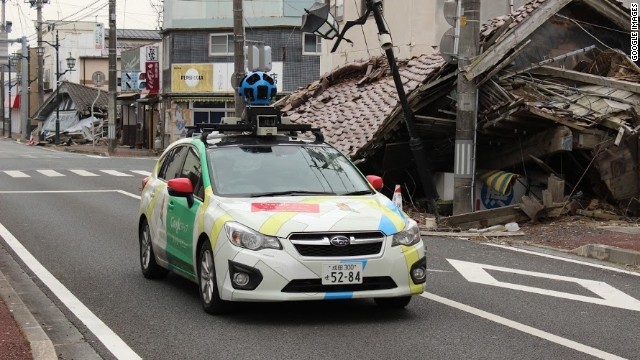
Google Street View maps Fukushima nuclear ghost town
Cars remain where they were crushed by falling walls two years ago, drink vending machines stand in gloomy isolation outside shuttered shops and traffic lights still blink amber in deserted streets.
It might sound like the
Hollywood setting for a post-apocalyptic dystopia but in Namie-machi,
Fukushima, the scene of desolation is all too real.
Two years after
Fukushima's nuclear power plant meltdown forced the 22,000 residents of
Namie to flee -- snap-freezing the ordinary Japanese town at the moment
the disaster struck on March 11, 2011 -- Google Street View has posted striking images of the devastation inside Fukushima's 12-mile evacuation zone.
"Most of the damage that we all remember and saw was the tsunami damage
because it was much more drastic," said David Marx, head of product
communications, Google Asia-Pacific, who accompanied the Google Street
View vehicle as it took 360-degree pictures along Namie's gloomily
abandoned and overgrown streets.
"The earthquake, even
though it was big, there was very little seen of just earthquake-damaged
buildings -- so many buildings were either completely demolished or
tilted or bent."
He said the scenes became even more dramatic as the Google vehicles approached the city's waterways.
"That area right next to
the river is just covered in boats -- there are just huge piles of
wreckage that haven't been cleaned up," he said. "It's pretty intense to
see."
Google's Street View cars
began taking the images this month at the invitation of the city mayor
who wanted a way for evacuated residents, many of whom are still in
temporary accommodation, to take a virtual tour of their abandoned
properties.
"Two years have passed
since the disaster, but people still aren't allowed to enter
Namie-machi," Mayor Tamotsu Baba said on Google's official blog.
"Many of the displaced
townspeople have asked to see the current state of their city, and there
are surely many people around the world who want a better sense of how
the nuclear incident affected surrounding communities."
Marx said the Google
drivers took precautions and their cars were monitored in line with the
Fukushima Prefecture and Namie-machi guidelines.
"I was wearing protective gear," he said. "The good news is that it's safer to be in a car than out."
While a recent who report
says the cancer risk from Fukushima is low, Japanese authorities are
taking no chances. The 12-mile exclusion zone is likely to remain in
place for the foreseeable future and Mayor Baba concedes that
generations of Namie residents may never see their homes again.
"Those of us in the
older generation feel that we received this town from our forbearers,
and we feel great pain that we cannot pass it down to our children," he
said on the blog. "We want this Street View imagery to become a
permanent record of what happened to Namie-machi in the earthquake,
tsunami and nuclear disaster."
Authorities took more than a month to begin looking for bodies in Namie due to the danger of radiation.
"After being set
off-limits, we have not been able to clean up the wreckage on the side
of the road, including the many fishing boats that were washed several
kilometers inland," Baba said
"Ever since the March
disaster, the rest of the world has been moving forward, and many places
in Japan have started recovering. But in Namie-machi time stands still.
With the lingering nuclear hazard, we have only been able to do cursory
work for two whole years."

No comments:
Post a Comment